Friday, 1 April 2011

108 Heroes - Tales from the Water Margin, a review


A modern interpretation of the classic novel.


The Performance Venue

It is a classical novel that has been widely revered in Japan, a subversive tale that was banned in China intermittently until the end of the Cultural Revolution.  108 Heroes - Tales from the Water Margin (水滸108 - 忠義堂) was my much awaited programme of the 2011 Hong Kong Arts Festival.  For a multi-arts performance like this, the Lyric Theatre of the HKAPA demonstrated itself as a befitting venue.  With the stage extended towards the seating area for design reasons, this arrangement incidentally helped induce a cohesion between the performers and the audience.  Also the compact seating and U-shaped layout managed to generate interactive vibes in the air that was not seen at the Cultural Centre and Kwai Tsing Theatre.


Collaboration between Taiwan and the Mainland

Laughing faces from left to right:
Wu Hsing-kuo (吳興國),director; Chang Ta-chuen (張大春),playwright;
and Chau Wa-kin (周華健), composer.


The Contemporary Legend Theatre of Taiwan was the brainchild of the production offering most of the creative forces on direction, playwright, music, choreography and design.  Meanwhile the Shanghai Theatre Academy provided expertise on Peking opera styling and most of the young acrobatic actors.  Without getting too sentimental, this joint project across the straits illustrated one form of pragmatic collaboration where one troupe might play a bigger role than the other.  It did not necessarily imply the dominant one would steal the show.  In this case, small roles by the young actors did.


Setting Limits to “Mix-and-Match”

Alexander Liu as Chao Gai, the original gang leader risen from death.


The eclectic array of classical opera singing and choreography, street dance, hip-hop, pop-rock (guitar and drum solos) were stimulating to the senses in the show.  It was deliberate that each category did not mix but instead arranged one after another.  The director was wise not to be overly ambitious to re-invent especially on the classical idioms.  There are limits to what we nowadays call “mix-and-match”.  Admittedly, the pop singing was a bit feeble with simplistic chorus lines and predictable melodies.  It rendered the performance with skeptical commercial overtones.


Visual Design of Characters

Xing Peng-yuan as Lu Jun-yi,
a righteous general turned gangster.


Liu Jin as Hu San-niang and Sun Er-niang, a dual role on two strong heroines.


I booked early for the tickets and was looking for seats close enough to see the details of the costumes, make-up and hair styling.  Quite a gamble but the catchy outfits highlighted in the publicity material was worth their share.  As shown above, the integrated visual imagery was fantastic and worked well as if to generate a cosmic reality of their own, a convincing parallel world of chivalry in a corrupt society.


Dynamic Use of the Stage

  Closer look of make-up on a warlord.  Note that there is a modern interpretation with naturalskin colour revealed.


It was another domain which shone.  The stage was extended with angled walkways against the front.  In between these narrow passages, there were pits where musicians were located.  The performers used these walkways extensively for marching parades one often sees in traditional Chinese opera.  The result was an interesting reference to fashion show and successful augmentation on the width of the stage.  In addition, there were unexpected shooting of arrows during fight scenes to the side of the proscenium that landed only a few meters from the nearest audience. It was daring and effective to stretch the horizontal boundaries of the stage.


I also liked the use of trampolines that were placed down in the pits.  During chase scenes, the memorable midget hero Wang Ying (played by Gao Feng) bouncing up and down from the stage line to evade from the pursuers was both spectacular and comical.  This added an extra vertical dimension to the stage apart from the usual split platforms above the stage.


A Dash of too much Sensationalism
Lin Chao-hsu as Shi Qian making a scene with a stolen chicken.


The monologue of Shi Qian on the stolen chicken was fun but a bit contrived and too elaborate to have definitive meaning. Personally, I felt the actor Lin Chao-hsu had already earned his place by spitting fire once but surely not three times.  For a first class artistic performance, there is unfortunately a thin line to draw between what is just right and what is excessive.  I once saw the Rocky Horror Picture Show in the same venue.  The performers were pretending to terrorize the audience towards the end of the interval at public areas.  Nice gimmick from a commercial plot, but I had higher expectation on an Arts Festival show.


Fatal Weakness
Wu Hsing-kuo as Song Jiang, the flawed pacificist gangleader.


The abridged storyline left out the core lesson intended by the original author on the notion of unquestioning loyalty that led to fatal consequences, in other words CRITICAL THINKING.  According to the novel, most of the gang heroes were sacrificed through Song Jiang’s leadership.   Chang Ta-chuen as playwright did not bring out Song's flawed personality as a simplistic loyalist over the emperor whilst leading a group of outlaws whose basic loyalty rest with the brotherhood.  There was too much bravado but not enough narratives on human feelings like betrayal, bigotry and greed.  This classic tale of chivalrous outlaws of 14th century is still very much relevant today.   But the message was not forthcoming in the show.  It was damning failure of a serious production that managed to leave the audience with lasting visual images, but very few on inspirations.




Monday, 21 March 2011

Venture of Culture in Hong Kong (West Kowloon Cultural Hub)


(This blogpage contains explicit materials some people might find offensive.)


The jury members of the West Kowloon Cultural District masterplan competition.  Can we feel culture in the air?


It is predictable yet woeful to know that Norman Foster has been chosen as the winner of the West Kowloon Cultural District masterplan design competition.  What can one expect from the SAR government and its design advisory board on issues of art and culture?  No wonder why the West Kowloon Cultural District Authority CEO, Graham Sheffield, had decided to call it a day in Hong Kong after a service of merely five months.  Smart move indeed.


When Henry Tang explained to us on TV that the overriding factor for choosing Foster’s scheme is its flexibility and ability to build the cultural hub in stages, one can only be dumbfounded on the extremely low quality mindsets the government officials have.  It is not design merits but normative practicalities that count.  And it is a crying shame they think so lowly the artistic judgment of the Hong Kong people when spelling out the reasons.


It is a situation tinged with anger and sadness.  One can only comment on this result with sarcasm and a bit of lateral thinking.


Behind the shades


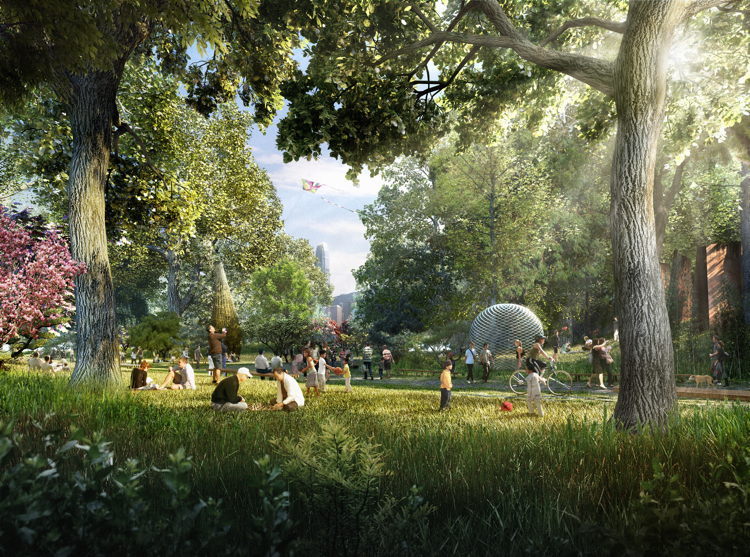
The concept of ‘City Park’ is seriously dated as architectural concept and anonymous to the Hong Kong context.


A truly visionary masterstroke from Norman Foster that the 19-hectare green park boasting leafy vegetation throughout, in fact, can effectively hide potential ugly museums and concert halls on the same site in future.  Remember the difficult facelift challenges we still confront with on the cultural centre and space museum.


Most expansive tree planting exercise in the world

Foster’s tactics of tree planting captivate the local folks.  Plainly speaking, he is a clever fox with long experiences in Hong Kong.


Just in passing, as the buildings play second fiddle and the infrastructure is designed to serve the greenery, how much does it cost to plant the trees in order to materialize Foster’s grand concept of ‘City Park’?  With an overall budget of 21,600 million and a target of 5000 trees, it takes a tidy sum of 4.32 million to grow a tree.  The leisurely strolling under the canopies of trees acquires a fiscal dimension.


Architect’s decision as God’s will

Lamentable poor souls that are trapped in an underground working space.


To execute on the beautiful vision of LOHAS, all car users are persecuted from enjoying day light and fresh air since all major vehicular roads will be sunken at subterranean levels.  Unfortunately, this applies to service vehicles in which support staff and delivery people would not have the choice to use public transport for their work.  Their only option is to consume flume and be exempt from natural lighting as far as their works are concerned.  Cruel and punitive formalism of boardroom decisions from the architect and the management.  Well, would they care?


Sentimental keywords always win the day

Sullen looking Rem Koolhaas too esoteric for Hong Kong.


Rocco Yim with lesson to learn.


Incorrect prevailing wind direction - one typical mistake from foreign architects including Norman Foster who do not care to investigate on the local environment.


Foster claims to achieve a carbon-neutral rating for the development.  The grey water recycling, heat recovery and solar energy strategies he listed out are nothing new and are almost as dated as the concept of ‘City Park’.  The wind energy generation is a token gesture at a very high construction costs, a pretty design toy for one technology architect like Norman Foster.  Rem Koolhaas, highly regarded for his avant garde thinking, would have sneezed at the idea of peddling mechanical provisions in the Architect’s Statement.


Playing Dan Brown in Hong Kong

The middle finger - ICC tower by KPF architects.


A ‘canon and balls’ statement boldly designed by Foster.


One codified message I read from Foster’s scheme is the egotistic phallic motif he planted on the grand masterplan.  After all, he has proudly pocketed four major projects in this city, namely the HSBC Headquarters, Chek Lap Kok Airport, the Cruise Terminal and this time, the West Kowloon Masterplanning.  With an inkling from the book The Da Vinci Code, Foster’s phallic statement boldly echoes with the middle finger hidden symbol dressed up as the nearby ICC building by KPF of the United States.  Such subversive messages for the innocent public of Hong Kong may prove too much to bear.


Tuesday, 15 February 2011

Yingge Ceramics Museum and afterthoughts on Bilbao.


Yingge Ceramics Museum, Taiwan


Identity speaking, Taiwan has always been overshadowed due to the unrelenting political victimization by mainland China.  This has damaged its strengths of cultural tourism as potential visitors would opt for neighboring destinations like China and Japan in the first place.


Permanent exhibition of local ceramic development.


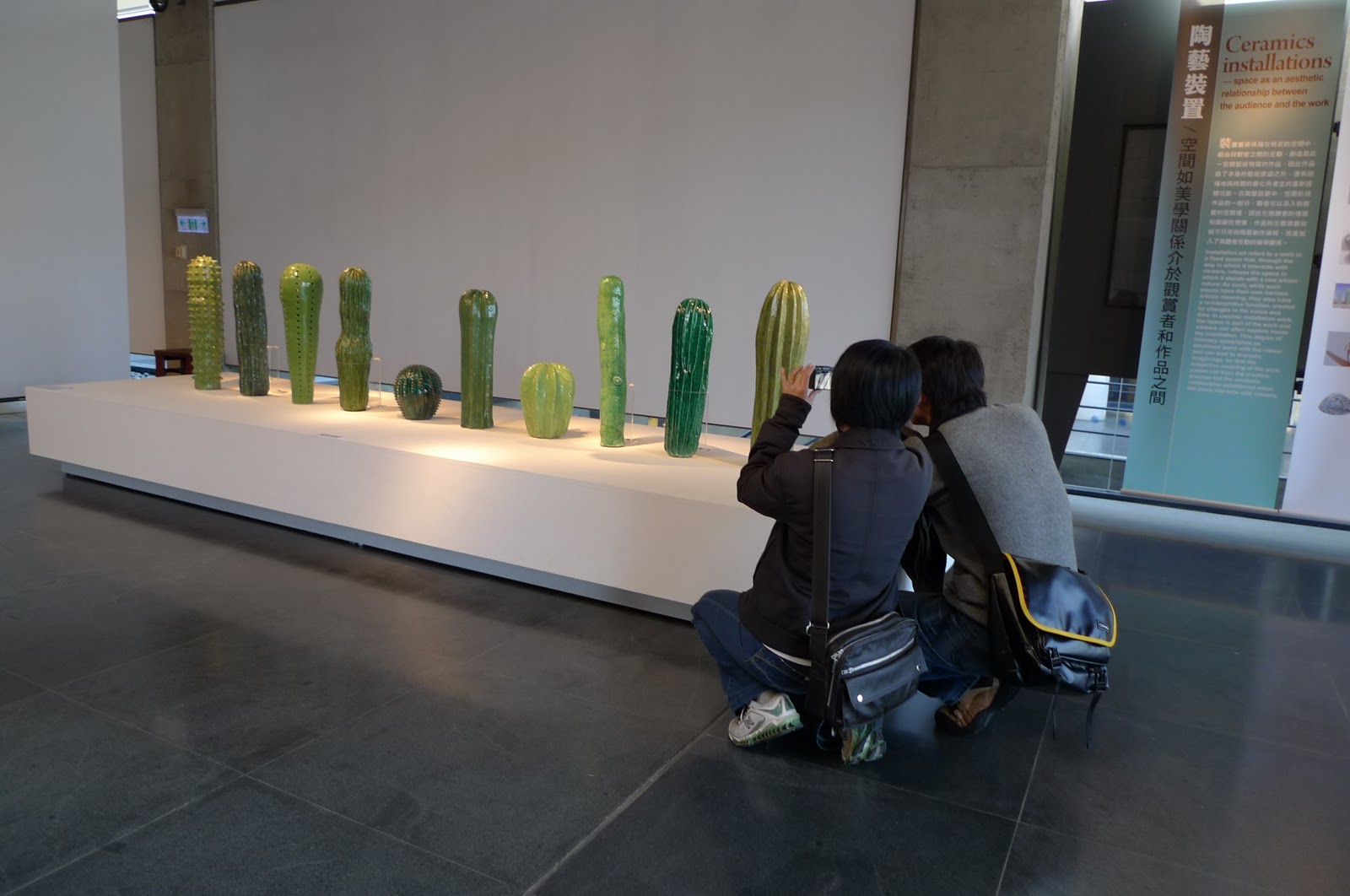
Yingge Ceramics Museum (鶯歌陶瓷博物館) of Taiwan, introduced here for readers, is an outstanding museum on ceramics.  My visit to the museum on December 2010 was worth the effort of 30 minute train ride from the city of Taipei.  The permanent exhibitions showing the ceramic folk art of Taiwan was a great vista to understand the ceramics development on the island, social-political transformations of the indigenous people, and from the Japanese occupation during the previous century.  The special exhibition on Spanish ceramic art displayed a high standard of art pieces and installations.  It was a personal discovery on what ceramics art has achieved and opened up thoughts on possibilities.


Serie Cactus by Lina Cofan, 2009


Nubes by Maria Bofill, 2007


Sin titulo I-V by Carmen Ballester, 2007


The museum also extends to a series of open parkland surrounding the building under the thematic names of Fire Arena, Earth Passage, Water Fount and Wind Channel, the elements that are indispensable in the making of ceramics.

All in all, the museum was rich in content, informative in its presentation and well managed.  From a close observation on the demeanour of museum personnel, be it concierge, security staff or even janitor, one could deduce how serious this establishment takes itself.  It was impressive in every detail.


Fire Arena


Earth Passage.  Yeah, a bit cheesy.


Water Fount


Wind Channel


The Guggenheim Museum in Bilbao immediately sprang to mind for comparison due to a recent visit.  Though located in different context, Yingge was definitely underrated whereas Bilbao, from this personal experience, was a let-down in general.  The shining titanium building designed by the starchitect, Frank Gehry, was a calculated hype that managed to lure flocks of visitors.


The label of Gehry was still a guarantee to success a decade ago.  The architecture as a shell was spectacularly predictable owing to its ubiquitous presence as quotable image; however the interior and exhibits did not live up to expectation at all.  It was a big budgeted project, to the effect of many Hollywood mega-movies loaded with big names, which did not endure in one’s loving memory.  Worse, after visiting hyped up museum like Bilbao, I occasionally lapse into the analogy of feeding on junk food: craving sensation beforehand but bad aftertaste to follow.


Expensive titanium cladding of Bilbao Guggenheim


Token interactive works by Richard Serra as part of the permanent collection in Bilbao.


Another article on Frank Gehry appears under the label of 'architecture'.


Tuesday, 1 February 2011

Demise of Egg House in Beijing


Egg House at public pavement.


Birth of an Idea

The 24 year old architect intern Dai Hai-fei (戴海飛) designed and built this ingenious home for himself in October 2010.  With around RMB6500 (US$1000), he built the egg shaped house that included a bed, small table and wash basin at the interior.  On the outside, it was cladded and insulated with sacking and glass seeds that was just beginning to grow in December 2010.  A small solar panel was installed to generate bear minimum lighting at night.  A green architecture true to form.


Bash all Non-conformists


His fast and unintended shot to fame through the internet, and later widely reported by conventional media, drawn in huge public attentions that relevant (or irrelevant) Beijing authority decided to remove Dai’s house on reason of illegal structure recently.

Overdose of Media Exposures

The China system, be it a way of life or implementation of law and order, can be surprisingly slack and varied.  This means the egg house could have survived a bit longer.  However by attracting too much attention, touchy to the Chinese government, the power of the internet and media this time has helped kill an innocent course.


A star is born, only very briefly.


Small sackcloths cladding the Egg House in detail.


At night, the house is simply surreal.


Nestled feeling of home.


Dai (third from left) was an idol outside the realty price spiralling game.


Monday, 24 January 2011

Derivative art doomed to be poor art


At the Beaux-Arts Ball of 1931 in New York, two dozens 
or so architects came dressing as buildings they designed.


William van Alen as Chrysler Building in company with 
unnamed female.


My memory proved me right that the image of people dressed up as buildings had crossed my mind before.  Oskar Schlemmer at Bauhaus was close but not the one.  It was the Beaux Arts Ball in New York, 1931 that I found in close resemblance to the work by Hong Kong artist Kacey Wong (黃國才).  The skyscraper attire was in every detail a derived copy of the Beaux Arts Ball costumes.  See images below.


"Drift City" in London.


"Drift City" in Egypt.


"Drift City" in Helsinki.


"Drift City" in China.


"Drift City" near the polar region.


Can it be purported to say that an artwork, ripping off from some notable piece, can be excused from due criticism?  Yes, only if one acknowledges the original; or it is a good art that transcends its precedent.  Minor art or parody can get away with murder but this is not the premises the artist seeks.  Wong claims that the work is arrived from the idea of an unnamed skyscraper pending demolition but suddenly disappeared overnight and found drifting around the world.  Perfectly solid but uninspiring, this postulation can be considered as one among many debates on lost identity in overdeveloped cities worldwide.

What is curious with the subject – a skyscraper awaiting demolition, is in fact a modern building not an historical one.  Maybe someone who dressed like an old building simply does not look as attractive as someone wearing a tall and slender skyscraper costume.  It could be the case that any thought of major changes from the original would debase a shaky concept.

Incidentally, keeping an old building can be a contentious issue and the issue is too complex for art to decide if the bulldozers should be called upon.  This also reminds me of what Rem Koolhaas said about people hypersensitive to preservation that even ordinary buildings of recent decades are being defended frantically.  Stripping out of context especially the urban fabric, an isolated discourse on preserving any building can be sentimental if not downright feeble.


Amélie, the 2001 film directed by Jean-Pierre Jeunet, coincided 
in timing with Kacey's snapshots around the world.


By any standard, the idea of “drifting” building does not worth the effort of spending ten years; and Wong claims that this is how long the project has taken from 2000 to 2010, posing with the costume around the world to demonstrate a fallacy.  It is absolutely a waste of resources from he himself and his sponsors.  The means does not justify the end no matter how much efforts and how long a time it takes.  The overworked photos only exacerbate the self-inflicted ridicule of the project.


Artwork of "Drift City" doomed.


Updating in June 2011:


Publication of the book - Drift City 10 Years 2000-2010, an unnecessary persistence on a dumb and pointless pursuit.