Wednesday, 16 October 2013

Sheepish drama of HKTV Network


(original image prior to touch-upGrimm)


The unexpected rejection of a free broadcasting license to HKTV Net by the Hong Kong SAR government is no ordinary sham. The storyline is, under a process of gradual transformation, the general public is turning into a pack of sheep in front of the telly. People simply don’t see themselves.


As always, the audiences in Hong Kong are only fed with melodramas, game shows and food programmes. No nutrients for the brain are meted out. It was high time to shake the couch, unplug the TV and wise up.


「香港電視網絡」的羊群戲夢

特區政府否決「香港電視網絡」免費電視牌照,酷似意外,實則展露非一般的愚民劇目。大橋段是經年累月以温水煮蛙方式將香港人奴化成公仔箱前的羊群。祇是大家看不透自己而已。

一如既往,香港的電視給觀眾盡是劇集、遊戲及美食節目,獨欠刺激思維的精神食糧。現已刻不容緩,大家離開梳化,將電視插頭拔掉並啟廸思考吧。


Thursday, 10 October 2013

Don’t soil the Mountain - landscape paintings by Yin Zhao-yang


石崖 Cliffs, 90 x 160cm, Oil on canvas, 2013

Detail


From political critique to satire on human frailties in the past few years, Yin Zhao-yang (1970 - ) has come full circle to tackle one of the essential subjects of painting, i.e. the representation of landscape.

Of the fifteen canvases in the gallery, some of them massive, but all of them were powerful display of vitality. Whether the heartfelt attentions are on the viscous layering of oils, delivery of brush strokes, richness of colours, they represent a tour de force of oil painting. There is a technical brilliance that is seldom seen on canvases these days. (With great shame, “technical brilliance” is sidelined none so ominously among all other arts than in painting.)

This series of oils under the exhibition title of ‘Descend the Mountain’ might lend to thoughts ascribing to literati paintings of the classical age(s) when painters eschewed politics and sought refuge in raw nature. With this cast of mind, the stage-set of obfuscation and pedantry contrived in the official description below would be better off buried:

“With Yin Zhao-yang, however, his veiled way of expression comes from his keen insight into the deep-rooted “crisis of statement” in which ”modern art” is trapped, an “expression crisis” that features nihility in face of myriads of critical perspectives. It is his artistic strategy towards the new world in the wake of ”the Financial Crisis” as well…*

Reading along this path would only soil the universality of landscape paintings.


綠潭 Green pond, 90 x 160cm, Oil on canvas, 2013

Detail


鬆石圖 Pine on Stone, 200 x 200cm, Oil on canvas, 2013

Detail


臥石觀雲 To appreciate the clouds when lying on rocks
200 x 720cm, Oil on canvas, 2013

Detail 1

Detail 2


*Page 43, ArtsLink Oct 2013, published by Hong Kong Arts Centre.


‘Descend the Mountain’ is held at Pao Galleries, Hong Kong Arts Centre from September 27 to October 10, 2013.


這山水,勿弄髒     〈中文摘要〉


遊走於政治批判及譏諷人性弱點的課題後,尹朝陽回歸繪畫基準之一:風景創作。

展館中的十五幅作品大多屬於巨型畫布,且全部輻射強而有力的能量。觀乎厚實的油彩層次、筆跡之起伏或顔色的豐潤,此批油畫所代表的造詣已臻頂峰。箇中拍案叫絕的技巧是筆者近年少見。(令人懊惱的現實是繪畫藝術已没有高超技巧的需要;反之,著重技巧則多遭鄙視。迄今這現象是其他藝術媒介所不能接受的。)

個以「出山」為題的展覽,內藏古典人文畫伏筆,表達作者逃避政治及隱逸於自然的渴求。但故弄玄虛及學究的搭台,包括下述的官方介紹則宜永久埋葬:

而在尹朝陽這裡,「筆墨」的隱晦言說,則源於他對「當代藝術」所面臨的深刻的「表述危機」——形形色色的批判姿態面對深層的精神虛無的話語危機——的敏銳洞察,也是他應對「後金融危機」時代新的世界圖景的一種藝術方案﹒﹒﹒”﹡

沉溺於以上的引言只會泥染具宇宙觀的風景畫作。


﹡十月份第四十三頁「藝訊」;香港藝術中心出版。


「出山」由二○一三年九月二十七日至十月十日於香港藝術中心展出。


Sunday, 22 September 2013

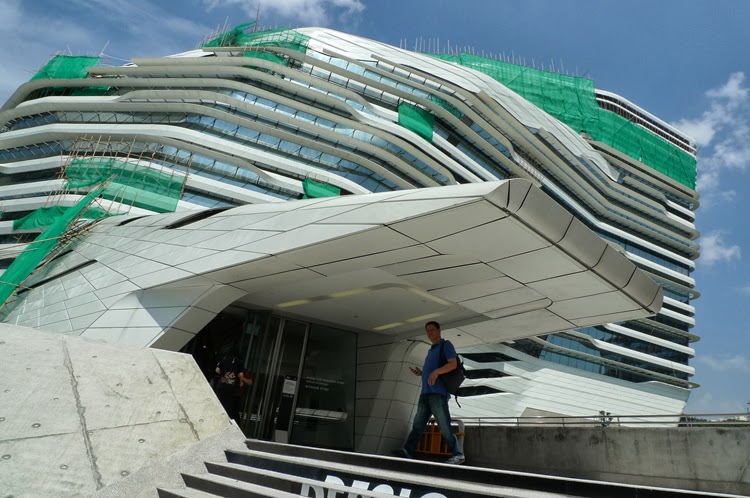
Innovation Tower – The future is difference


“Our designs dissolved the classic typography of tower and podium to create a seamlessly fluid new structure - establishing a vision for future achievements and referencing the university’s rich tradition.”

Zaha Hadid on Innovation Tower, Polytechnic University Hong Kong


Photogenic mug-shot of the massive building in the campus surrounding.

It looks like a giant sailing boat marshalling in a sea of docile red-brick buildings.  The opportunity was there, albeit lost chances in the past, to rescue the campus from a humdrum of forced homogeneity.  On this course Zaha Hadid, chosen for the task to break the mould or any mould, has a track record of successes.

As in most of her works, the public attention on the design school is measured by the degree of how disparate it appears in its immediate context and beyond.  The plastic volumes, intersecting profiles and sleek bandings applied are conducive to a forward-looking expression, so positive that there requires a mandatory disconnection with learned experiences and cultures.  To expand further, the school is a visual hagiography of optimism, not much different from the utopian visions of Oscar Niemeyer in Brazil of the 1960s and only comparable to the upbeat commercials of digital gadgets penned by advertising executives in our cyber age.

Futuristic buildings - a description shunned by Hadid on her works but used by most people nonetheless, are hard to relate.  Their purveyors operate on the belief in the future; and for this reason they must distance themselves from the past including established conventions and values.  Metaphor-making on these works can be tricky because they are inherently “progressive” in appearance, any mind-mapping must be equally progressive to be favourable.  Therefore, it is easy to make a joke on them metaphorically, but difficult on a commendation.  Along this lead, most people fail, me included.  With embarrassment, my best shot of a “giant sailing boat” is pathetically old-world.


The followings are some observations from a recent visit and published drawings.


 The building is heavily bandaged with 
remedial works all-round.

(photohttp://overover.com)
Aerial photograph showing the solid roof above the wedge-shaped entrance.  Whoever has the common sense to relinquish roof glazing at the entrance is a good deed against energy-wasting and greenhouse discomfort. 

Original design with full glazing sensibly scraped finally.

There is not much logic to where the sun-breakers (white bands) are located.  Many of them even wrap around the north side.

Series of white banding and awkward massing
 exacerbate visual distortions.

The building looks clumsy at the road side.  The same misgiving occurs in some of Hadid’s works in which broad-brush approach to volumetric handling seems to dictate over attempts on refinement.

The other trademark with her buildings is the fact that the roofs join the walls without gutters separating them.  This lack of detailing is hell on weathering performance; in simple terms, the dust collected on horizontal surfaces will create strands of stain on walls.  For cyber-tech works including this, smeared surfaces are signs of weakness and pessimism.  They are an irritation that keeps coming back.  See the same problems on the Ordrupgaard Extension below:


Floor Plan (+18m from ground)

Floor Plan (+38m from ground)

It is not sure why the lecture theatres are located at the middle section of the tower except an urge to be different is too overwhelming.  This is inefficient spatial organization and is inflexible for possible overhaul in future.

Longitudinal Section 
(above drawings and renderingZaha Hadid Architects)

Apart from the unconventional location of lecture theatres, it is strange to find that some internal walls are slanted on this drawing.


(interior imagespurple li@http://purpleli.com)

These dramatic interiors are no ordinary learning spaces.  Furnishing for the interiors is difficult as stylistic concerns always get in the way of pragmatic needs.


未來就是異樣 哈廸之賽馬會創新大廈   〈中文摘要〉

這棟新厦仿如一巨型帆船疾駛於溫婉的紅磚建築海中。在理工大學校園的同質建築群裡,過去曾出現設計突圍的機會均全告落空。而今次受聘的哈廸,成功地運用她破格不二之法,其成果可謂發揮得淋漓盡致。

貫切哈廸的風範,公眾目光的多寡往往建基她的作品與周邊環境和脈絡之差異大少。此設計學院的建築塑體展示、交叠輪廓及繆巧線條皆予人前瞻感覺;這正面的表徵卻源自對固有習性文化歷煉的决裂。簡單說,這建築物充溢著讚頌未來之意,與上世紀六十年代奧斯卡.尼麥耶在巴西里亞構建的烏托邦式建築同出一轍。然以今天角度,最多只能與媒體創作人愛塑造的電子產品廣告媲美

盡管哈廸不接受作品被冠名「未來派」,普羅大眾卻紛紛樂於引用這稱謂。無他,人們對這類抽象建築造型難於連繫。而這設計師為宣揚美好將來的概念,需刻意與傳統價值及既定法則保持距離。若以隱喻法論述相關建築,觀其排斥性外型,情况特別狡黠;皆因正面思索應配以先進比擬例子,這點不易。所以揶揄它們實屬易如反掌;但若是讚譽的話比擬須冠以同級〝先進〞例子,難度則高矣。循上述思路考量,大多數的嘗試難免失敗,本人亦不例外。不畏靦腆底下,筆者在上文引用的「帆船」比擬亦逃不出舊世界思維。

其他有關對創新大厦的圖片個別評論,見英語本。


Tuesday, 3 September 2013

Bruce Lee – Visionary Punches


Rushed to the hospital from an actress’s home and died at the height of his film career, Bruce Lee (1941-73) is a classic Shakespearean tragic-hero who is still a legend since his demise on 20 July, 1973.  He is an epiphany of a typical high school drop-out, winning Cha-cha dancer, charismatic actor, teacher and sportsman all rolled into one.


The organizers disallow photo-taking in the venue, 
hence the photos taken hastily are less than desirable.


The exhibition, set to run for five years, is an unprecedented result of a joint effort pulled together by the Bruce Lee Foundation, curators and individual bodies.  A large collection of memorabilia has been amassed from various sources to reveal different stages of his extraordinary life.  In the aftermath of recent bickering over a permanent venue dedicated to Lee sadly turned sour in Hong Kong, this is the best effort yet in a worldwide level.

Lee did not simply leave a lasting impact on martial arts forty years after his death.  His integrated adaptation of boxing, karate, Wing-Chun and other schools of fighting is a cross-discipline forth-runner of selecting the most effective means to achieve a goal.  In other words, it is the pursuit of efficiency, unbounded by doctrines, so highly valued in contemporary problem-solving process. 


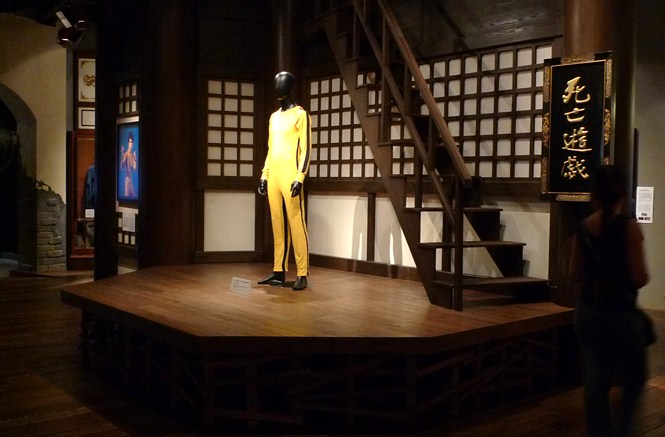
The yellow jersey, not related to the Tour de France, is the iconic costume worn by Lee in the half-finished film – The Game of Death.


The mirrored wall from “Enter the Dragon” is reconstructed though without much vibe.  The China-town impression, blindly adopted by local curators, makes one feel tight-fisted with anger.  On the side note, I would recommend “Fist of Fury” for those who have not seen his films.  Honestly most of his other films should be viewed solely for personality-following purpose.


Two sketches among many by Lee explored the possibilities of fighting sequence in his films.  More daunting is his scribble of physical exercises to be taken on an hourly basis (not shown here). His dedication to body fitness put most people into shadow.


A toy-sized burial ground intended as a joke for a friend.  The inscription reads: In memory of a once fluid man crammed and distorted by the classical mess.  It is still a relevant guard against bigotry and self-righteousness.  To me, this is the essential contribution of Lee that stands the test of time.


The big-budgeted exhibition setting is largely based on the actor’s childhood home.  The deco is a bit nostalgic for liking yet the result is not as cheesy as imagined.


A more contemporary throw near the exit focuses on the play with Lee’s quotations through interactive means.  One of them says: “Empty your mind. Be formless. Shapeless. Like water.”


Bruce Lee: Kung Fu-Art-Life is held at Hong Kong Heritage Museum from 20 July 2013 to 20 July 2018.  Check the official website for film showing time prior to visit: www.heritagemuseum.gov.hk.


「武.藝.人生 李小龍」   〈中文摘要〉

他從女星丁佩香閨被送往醫院,在最瘋靡影迷的時候暴斃,李小龍是莎士比亞經典悲劇英雄。他亦集頑皮輟學生、恰恰舞冠軍、魅力巨星、導師及運動員各優點而成為神話載體。

此展覧由李小龍基金會,相關策展人及有心人仕聯合籌備,規模不可多得。而展出的大量珍藏,包括他在聖方濟書院的文件均可窺察其生命歷程之一二。觀乎近年擬建永久館的風波,項目最終付諸流水;這盛事不愧是歷來最高水平的「小龍」展覧。就場地設計牢困懷舊色彩,部份更有唐人街感覺(即西方角度的典型中國特色),筆者只能無奈視此番枝節乃習以為常之蹩腳毛病。

小龍不單為武術遺留長久而深遠的影響。從西洋拳、空手道、詠春及其他格鬥派別所融會的武學其實可解讀為跨學科思維模式的先驅,以最具經濟和便倢之道達成目標。這就是當今世代所崇尚,師成本效益之策以解决問題的信條。


Friday, 30 August 2013

Photo Journal: Tokyo 8.2013 (part 2)


Museum Visits

Tokyo National Museum (東京国立博物館) at Ueno Park. 

  The Japanese Gallery looks dated and does not have a great depository of its national arts as anticipated. Comparatively speaking, the collections in Asian Gallery on right is richer in quality and better by display.  I happened to miss out on The Gallery of Horyuji Treasure (法隆寺宝物館), which is positively smaller but nicely contemporary in design.  This gallery and the Museum Garden (with restored Edo timber buildings) would justify a revisit to Ueno Park.


The Gallery of Horyuji Treasure on left and
 Museum Garden on right. (imageswww.resonate.co.nz and www.sunlaushi.exblog.jp)
  
  The latter with tea houses is open for two periods of time in spring and autumn only.  


Three-storey Asian Gallery with artefacts spanning from the Orient to the Middle-East.


Stone sculptures and relief works dominate the venue. 


Tang dynasty pottery figures remind one of the Star Wars princesses.


Rare collections of Egyptian and Mesopotamian art are present.


American pop art and photographs by Andreas Gursky were on show at the Tokyo National Art Center (国立新美術館) in Roppongi.  Having seen in other places, I skipped both to lunch at Brasserie Paul Bocuse Le Musee on one of the giant drums and acclaimed locally as a value-for-money establishment. 


The foyer is packed with three restaurants and café, cutlery clanking fills the high ceiling.  The museum entrance has the impression of a trendy hotel lobby.


Seductive curves of the external wall summarize this work by Kisho Kurokawa (黑川纪章, 1934-2007).


Passed Aoyama Prada in a leafy neighbourhood is the Nezu Museum (根津美術館).  The little custodian of oriental arts was completely remodeled by Kengo Kuma (隈研吾) in 2009 after the initial opening in 1940.


The foyer overlooking the garden.
  
The building is deceptively simple in design. Yet it is loaded with values underscoring Japanese design philosophy - simplicity of expression and efficiency of use.


The clever use of real bamboo shoots screens the site away from the busy traffic outside. The resulting long possession towards the lobby allows people to prepare for the mood of museum visit. 


My flight schedule prevented me from a proper visit of the museum.


Floor plan showing the revered café nestled in 
garden setting. (imagewww.architecturalrecord.com) 

As the terminating point of the fashion walk along Omotesando, Nezu would make up a peaceful winding-down of any visit schedule.  


Kawagoe (川越)


This small town of 30-minute journey from Ikebukuro Railway Station retains the old charms that has disappeared in down-town Tokyo, hence the affectionate name of “Little Edo”.  Despite the fact that most buildings are replicated from the past, the time-honoured urban fabric is preserved. The Tower of Bell, initially constructed for fire warning, tells the time once every fifteen minutes.


Amid tourist trails, there are genuine domestic neighbourhoods around.


The traditional Japanese house is where the architectural influences of the Tang yynasty (618-906) from China remain traceable.  It had been revealed that the US government consulted the Chinese architectural scholar Leong Si-cheng (梁思成, 1901-1972) prior to the massive raids of Japan towards the end of WWII.  Leong advised that Nara (奈良) and Kyoto (京都) be spared due to the fact that its existing architectural heritage even surpassed those remained in China.  


Thriving street life and interesting shops abound.


People, in formal attire, paying respect to shrines at the famous Youjyuin Temple (養寿院).


Buddha with serene gaze at the cemetery of the temple.


Observe the beautiful piece of paper weight on free booklets for visitors.  This unguarded snake ornament would have been pinched in most countries.


Country at Crossroads


Amid the economic downturn from the 1990s up to now, the Japanese government has tried various fiscal policies to dig themselves out from what is known as The Lost Decades (失われた20Ushinawareta Nijunen)One of them is the bidding and eventual selection to host the 2020 Summer Olympics.  Will this city, indeed the whole country, get out of the dogged recession and go through another economic miracle just as it did half a century ago?


Understanding the People

Without actual fieldwork at the time, much of Ruth Benedict’s distant anthropological work The Chrysanthemum and The Sword, 1946 is still relevant.  Distance is relative, being near does not automatically imply that one has a clear understanding of things.  On this occasion, photographic narratives are correlated as impressions for readers.

Beauty and cosmetics are huge businesses here, the alternative pedicure massage at the entertainment district of Kabukicho (歌舞技町) offers a quiet spectacle.


The Japanese sense of aesthetics and attention to detail can be overwhelming.  In this instance the shop sign (framed at centre) of an unassuming gift retailer was the kind of laconic composition that impressed me when I studied graphic art years ago.


Sushi-making has quintessentially the virtue of dedication wrapped within.  A proper chef often has to go through years of apprenticeship before starting to learn the trade proper.  The traditional way is that most people would stay in one business and earn their time-honoured expertise.


It is quite unlike Stephanie Key, the daughter of the New Zealand Prime Minister and an art student, who manages to shoot to fame in no time by posing as sushi-on-naked-flesh (女体盛 nyotaimori) for her photographic show in Paris Design Week in September. (imagewww.dailymail.co.uk)


The Japanese zeal for outsmarting nature can be admirable but at times intimidating such as their humanoid robot technology.  Fresh fruits grown in this country can command tens of dollars(US) a piece.  The fruits photographed here, completely artificial but tasty anyhow, are usually presented as novel gifts.


If the molesting giant monsters from the film “Pacific Rim” prove to be too hard to swallow for fit minds, the wholesale obsession with kaiju (literally “strange beasts”) is much to be found in film, TV, comics, and toys.  This institutionalized attachment is deeply rooted in the modern Japanese psyche.  The preoccupations with great disaster and impending destruction, whether to do with the perennial threats of earthquakes and experiences of atomic bombs, have been elevated to the level of totem worship.  The kaiju characters, collective embodiment of such obsession, are simultaneously feared and worshipped.


The antagonist of monsters – Ultraman Ginga is celebrating his 45th anniversary of busting villains this year.


Japan Sinks (the English translation of 日本沉沒
by Sakyo Komatsu (小松左京, 1931-2011).  

  No country is more obsessed than Japan when it comes to doomsday paranoid.  The book, spun off with TV drama, film releases in 1973 and 2006, has a cult following since its publication in 1973. Flashes of the old film still remain intact in my mind.


It is said that the annual revenue drawn from pachinko business is bigger than the car industry in Japan.  The popularity of these steel balls is a legendary myth to gaijin (foreigners).  Perhaps it takes one obsession to fend off other obsessions.  Most joints are operated by yakuza gangs and photo-taking remains off-limits.


These cosplay gears were not photographed in a sex shop but superstore admittable to all.  They are an extension of the addictions to manga (comics) and anime (cartoon).  The costumes are accepted by all walks of life and are seen worn night and day.  Kinky, risqué, kitsch or corny are no words to label this phenomenon.


In contrast, enduring hardship as portrayed in this bronze arhat monk is buried deep in the collective psyche.


The same attitude of endurance is expected of in real life – in this photograph, scores of participants bathed in icy water at the Teppozu Inari Shrine (鉄砲洲稻荷神社), Tokyo to purify their souls. (image/www.ansa.it) 


War and Peace


The Tomb of the Shogitai Warriors (彰義隊墓所) at Ueno Park says: “At the fall of the Shogunate Government in Edo, Shogitai warriors resisted the new Meiji Government to the last and died here on Ueno Hill”.  Even though the Meiji is unequivocally regarded as the government that lift Japan into the modern world, no samurai, whatever their cause, would be forgotten had they done honour to the country.  This no-surrender mentality is a double-edged sword of pride to themselves but incomprehension to others.


Right-wing militant groups at Yasukuni Jinja Shrine (靖國神社) commemorating the 68th anniversary of atomic bombing in Hiroshima on the 8 August.


The whole parade was intense to the effect that there was complete dead-air and everyone stood aside to watch.


The large shrine is where the Japanese WWII dead soldiers are worshipped.  They include those who were classified as Class-A war criminals by the Allied judges of the Tokyo Trials after the war.  Protests in many Asian countries are fervent whenever the Japanese government officials esp. the prime minister visits the shrine.  This is the background of my visit to the temple.


Deep in the compound of the shrine is Yushukan (War Museum) exhibiting Japanese arsenal and their version of military aggressions in Asia from the 1890s to 1945.  Foreign visitors may not notice this plain-looking establishment but this is the place to see the shadow - in Jungian terms the unconscious, which gives light to the conscious.    
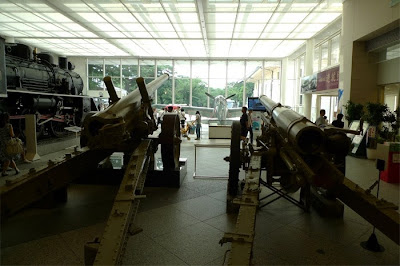

Apart from the killing machines, a train engine on display paints the story of economic contributions to Thailand and Burma during the war years.  Tens of thousands of POWs and civilians from Asia and the west were forced to work and died during the construction of the so-called ‘death railway’. (The Bridge on the River Kwai and more recently The Railway Man retrace the stories on the wide screen.) The works was presented as a local contribution in the ‘Greater Asia Co-Prosperity Sphere’ unilaterally imposed by Japan to other Asian countries.    This museum, reflecting so different in attitude to those in Germany, is designed to justify a colossal mistake than to provide lessons for the future.  


New developments of the city across Tokyo Bay.  

  In the context of persistent economic downturn, jitters with neighbouring countries and constitutional reform of the military, it is in everyone’s concern to see what direction Japan is heading.