Thursday, 19 June 2014

Seven

virtues, deadly sins or pure medicines


Erotic Paradise – No.1 Enjoyment
‘No one knows what you are doing, 
but you should trust and cherish in company.’


Erotic Paradise – No.2 Self-immolation
‘Self-protection can never fulfil yourself. In order to give, 
you should be ready to sacrifice.’


Erotic Paradise – No.3 Drafting
‘You have no abode when travelling. You should make friends to call 
everywhere your home and everyone your wife.’


Erotic Paradise – No.4 Radicalism
‘Exiled with no support, all your efforts are in vain. But be prepared 
for struggles any moment.’


Erotic Paradise – No.5 Stinginess
‘Spiritual sharing is difficult, and physical sharing is dangerous. 
You should learn to be alone and enjoy yourself.’


Erotic Paradise – No.6 Misdeeds
'Being unloved is the biggest stigma and suffering. But the pain of love 
is sweeter than all other joy.’


Erotic Paradise – No.7 Hypocrisy
‘Don’t be scared of your desires. The truths for life lie in kindness and positive steps towards their realization.’


Traditional mimeographs on cotton papers by Hou Chin-ming, 1992.

Joint exhibition under the title of
Ten Million Rooms of Yearning. Sex in Hong Kong
10-25 May, 2014 at Sheung Wan Civic Centre

(Seven mimeographs are exhibited instead of eight in total;
English translation slightly modified by Sundial)


The above male assertions may be seen as partial and incomplete 
counterpoints to


七德圖之說
是七宗罪,還是七劑藥

侯俊明之《極樂圖懺》系列,油印綿紙

展於201451025日上環文姘娛中心
題為《熱望之房性與香港》聯展的部份

(原系列共八圖,只有七圖展出。原文的英文翻譯經筆者調整)


上圖的男性角度可被視作〈林介文與性的話語〉
的一只乾坤配對。


Sunday, 25 May 2014

You/me, Martin Creed and Lee Kit


‘We all know joy and loss. We all spend
most of the time in some nameless mood
between these two extremes. Sometimes,
I get nostalgic, and I start to reminisce.’


 ‘It’s all up to you, while I started to forget something.’

‘My impression of you is hard to comprehend.’


‘Sunday morning it feels like shit.’


‘I might be thinking about my family,
my partner, some nonexistent corner of
the city, or some person I saw once but
never really met.’


‘Sometimes, sharing is an odd concept.’

 ‘Details are blurry.’

‘Judy, where’s the carpet?’

(All above texts taken from exhibition and 
official programme brochure.)


In the mood for thought

The lofty rooms of Cattle Depot Artist Village looked almost empty. There was no eye-catching exhibit guarding at the entrance, nor was there any lavish piece anchoring at the centre; and down were all the spotlights that one might suspect to have arrived at the wrong time. With the T-shirt hung from the wall, the open parasol, the beach chair, the stand-alone bucket, or the prefab guardhouse strategically arranged, one began to discern that these unassuming objects were art installations – or ‘settings’ according to the artist. Together with the micro-situational video works and canvases of blurred imageries, Lee Kit spelt out his participation in the 2013 Venice Biennale on home turf under the new title of ‘You.’. Incidentally, somewhat ponderous but consistent with Lee’s reflective programme, ‘You(you).’ was the title of his entry at the biennale.


Under the dramatic truss roofs of the former slaughterhouse, art was carefully staged and its materiality was suppressed to attain a symbolic state of non-presence. This is the dilemma for conceptual artists who engage in minimal visual expressions, knowing at core that by reducing their works to unrecognizable anonymity the identity of an artist ceases to exist. Hence for the most reduced form of paintings by Yves Klein, so to say, there are the barest frames and canvases to exist; for any Beckettian theatre, there is the performer(s) with or without the stage; and for the ambient music of Brian Eno, there are yet detectable sonorities however close to silence.


The white bench and fire extinguisher as art pieces, perhaps?


In ‘You.’, through the array of self-effacing settings, the artist took to the viewers’ psychological automatism to experience their visits and to respond instinctively without direction from the mind. For this reason, there were no titles for all individual pieces to convey any specific messages; thus for Lee, visual tectonics were reduced to essentials and interventions to audiences’ responses were minimized. For meditations on ordinary presence, one might even take the old fire extinguisher on the wall as an inspiration for personal revisitation. The idea that everything is art and nothing is art - heralded by Duchamp through Fountain 1917, is reinterpreted by Lee a century later.


The Lure of Pure Essence


In causal terms, time is the order of duration and duration supposes time. The quality of the responses from audiences, however indeterministic, is built upon acquired experiences. The spirit of Lee’s programme lay on the open-ended interactions between the artist and viewer. Admittedly, there was nothing esoteric among the exhibits though plenty of tantalizing ambiguities were mapped out for interpretations. But there might be gaps where communications break down and the audiences including my wife hit a blank wall. Personally, I had moments of irritation from the equivocation of his settings. His texts, with a literacy that carried meagre inspiration, make reading an unpalatable act for avid readers.


Lu Shou-kun, Zen Painting, 呂壽琨,禅畫, 1964
(Imagewww.yishu.net)

Liu Gou-song, Midnight Sun, 劉國松,子夜太陽, 1970
(Imagewww.theedgegalerie.com)


There exists a tendency to distill the representation in art, thinking that the less the narrative contents, the purer the concept will remain in a work. It is tempting to equate verses in writings with expressions in visual art and arrive at the conclusion that more is excess. The same rationale applies to the inclination to avoid specifics. From what had been learned in the 1960s-70s that the New Ink Painting Movement in Hong Kong had grown into believing that the historicist shackles must be broken. A liberation from ethnic adherence was in earnest and universal values, understandable to all, could be achieved. This self-fulfilling group of artists immersed themselves into subjects of cosmic pondering, religious refuge and other abstract reveries. Their mutual influences gradually developed into an upward, or downward if you like, spiral of reductionism; and as such an inflated nothingness leading to a total detachment from audiences was resulted.


The Sage and Joker

It is inconclusive to suggest that this development of ink art had its inspiration from the minimalist art that thrived in the west of the same time. Further afield in our own time, both movements of then have their point of reference to Martin Creed who stretches the blandness of anything and everything in the visual world to extremes. His contributions to contemporary art, however controversial, at least can be commended on merits of honesty and self-mockery. In unembarrassing terms, he keeps telling everyone that he doesn’t know what people like in his works and “don’t know”s are invariably his favorite answers to questions*. To understand his phenomenal success, it might require extraordinary objectivity in order to bring to light the ridicules he produces that mirror our everyday lives. (In interviews, he always repeats that he doesn't know if he is an artist; hence it is fair to use other terms than ‘artwork’ to describe his creations.)


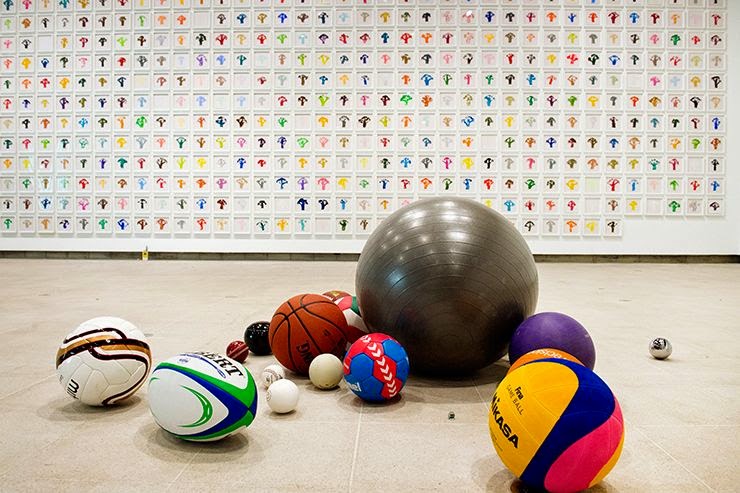
All photos above and below from Martin Creed’s major retrospective - What’s the point of it? 
Hayward Gallery, Jan-Apr. London, 2014 (PhotosLinda_Nylind@BlouinArtinfo)


In ‘You.’, Lee’s carefully constructed art has an appeal of freshness among contemporary excess – that is an anticipated result. His works of intended ordinariness or even blandness, share much in common with Creed’s. The difference between them may be one of ascetic positivity versus playful wickedness. On Lee, it may be tempted to say that, given the melancholic traits of his works, a certain Stendhal syndrome permeates among thinkers. In contrast and less guarded in manners, there are plenty of nauseating fun with the British artist that cannot be separated from his absurd looking works. As always, one has to examine the artist’s personality in order to understand his or her works. It is this honesty, however brutal it might be, one yearns from Lee.

The restraint in elaboration on works and written narratives can certainly keep Lee Kit in the safe zone. So far so good. But like the liu-bai effect (lit. leaving blank) in ink paintings, the clear-cut visual imageries and meta-physical inclinations, however enticing they can be, may lead to serious withdrawal consequences from audiences due to a lack of connectivity. It is more acute when the poise for serious thinking by artists becomes predictable. Before Lee is pushing the limit of open discourses in future, I hope he can tell us more of himself and through his works than otherwise.


*Recommended YouTube interviews and talk with Martin Creed at here:

1. Martin Creed interviewed by Fanny Keifer, part 1 of 2 https://www.youtube.com/watch?v=9cm-MZ3bj8Q

2. Martin Creed interviewed by Fanny Keifer, part 2 of 2 https://www.youtube.com/watch?v=VWIR_92jmb8

3. Meet Martin Creed (with performances) https://www.youtube.com/watch?v=hdWSOL7x3LA


‘You.’ – Lee Kit

6 March to 13 April, 2014 at Cattle Depot Artist Village,
 Hong Kong


/ - 游離于馬田.克特與李傑之間     〈中文翻譯〉


我們都知道快樂和失落。大部份時間,我們
都在這兩個極端之間、難以名狀的情緒之
中。有時侯,我開始想念、思憶。

「既然我的記憶力已逐漸減退,就隨你吧。」

「我對你的感受難以言喻。」

「週日的早晨像屎一般。」

那對象可以是我的家人、伴侶、某個已不
存在的城市角落、或是某個曾遇上卻不認識
的人。

「在某些時候,分享是一個奇怪的概念。」

「細節很模糊。」

「朱廸,地毯在哪兒?」

(以上文字摘取自展場及官方文宣)


此刻愛思考

寬敞的牛棚藝術村呈空置模樣。不只大門入口不見耀目的展品,館中央沒有壓場大作,連鎂光燈亦被關掉起來,觀眾有誤以為在閉館時段到達。及後閲畢牆上的汗衫、傍置的水桶、預製更亭、張開的太陽傘及沙灘椅,我們方始領悟這些不經意之物其實是展覽的裝置,或按藝術家的稱謂 佈置(setting)。加上處境式的「微觀」錄像及隱晦的畫像,李傑將2013年威尼斯雙年展參加的作品重置于本地主場,並採用「你。」這個新標題。以資參考,「你(你)。」為該雙年展的名稱。雖然有點累牘,兩者的連貫性依然。

在牛棚的桁架下,李的作品得到仔細的鋪排,但牠們的實物狀態卻被壓抑至「非存在」的象徵境界。這是概念藝術家運用簡約表現手法卻常陷於困窘之情况,理由是他們通曉若作品簡約至不復辨識境地,他們的自我身份亦隨之煙沒。因此,算是多麽勵節的繪畫,一如伊夫.克萊(Yves Klein),他的畫布及框架還是不能或缺;多麽貝克式(Beckettian)戲劇,縱使沒有舞台,表演者依然存在;多麽前衛的環境音樂,白賴仁.伊諾(Brian Eno)仍須在淵肅的背景上賦予音效,那怕是最輕聲的蹤跡。

通過連串不經意的佈置,李傑務求將觀者的直覺反應釋放出來。至此,展品均不設名稱,以免傳遞具體訊息。在「你。」的作品集,視覺構築以精鍊為尚,自主思維的干擾亦減至最少。面對場館的平凡事物,那管是牆上的滅火器,它們有助重建觀眾回憶的幽徑。由杜尚的〈噴泉1917〉裡倡導之念 “物物皆藝術,無物是藝術”,在一個世紀後,李氏得再演繹。
                                            
精鍊的誘惑

從因果先後述,時間乃歷練的格致,歷練需以時間為先。無管有多少非定命性,觀眾的反饋質素,總離不開個人累計的經驗。「你。」戲碼的精髓在于藝術家與觀者沒有前設的互動。誠言,作品不存在艱深苦澀之處,只有暗藏虛實供詮釋。但這裡同時藴藏不少隔閡,導致交流斷路。觀眾其中包括內子同樣不免碰壁,小吃悶棍。就現塲竊念,筆者面對部份含混的佈置亦難掩懊惱。他的綴句,在語文層面欠啟發、敗景意;對愛文字者言,閲讀彷彿是苦差。

淨化藝術表達的向性在于相信減少敍述內容後,作品的概念定當更純粹。我們很容易將寫作的文筆與視覺藝術的表現相互評較,對「多則冗贅」的論說趨之若鶩。同理,但凡具體的描述亦應避之則吉。借監196070年代的香港新水墨運動人士深信歷史的牢鐐須被砸爛。當民族的包袱鬆綁過後,普世共詠之大同境界則指日可待。至此,這群自我感覺良好的藝術工作者沉醉于天地的冥想、宗教的藩籬及其他抽象物意的讚頌。他們的互為影響,循簡化論傾向,往牛角尖深處裡鑽。就這樣,一個澎張不堪的假大空,完全脫離群眾,最終亦為這個運動蓋棺謝幕。

智者與謔師

新水墨運動的產生和發展是否源自西方同期的簡約主義,這裡暫且沒有結論。但兩個流派與今天的馬田.克特(Martin Creed)擁相當的參考價值,特別是他擅於尋找視覺世界裡的乏味事,那理大小,只管推至極端,。當然他對當代藝術的貢獻極富爭議,但至少在真誠及自謔兩個層面他卻值得讚譽。在沒有丁點兒尷尬下,他常說不明白在啥處人家喜愛他的作品;而“不知道”更是他慣用回應問題的答案*。要了解他成功之處,我們需抱有高度客觀性,摒棄偏見,才可顯現其創作的荒誕 那股表露現今生活之實况。(用偏離藝術語言來形容他的作品還是公平的,蓋他亦經常重複說自己不是藝術家。)

李傑細心構建的「你。」在今天的泛濫世代讓人有十濁一清之感,帷這是可預計的。他經營的尋常性甚或木訥感與克特的作品有異曲同工之妙。他們之別在於前者帶克己的積極性及後者愛玩的黠慧。在李傑的作品裡,考其悲天憫人之踪迹,也許多少司湯達綜合症(Stendhal syndrome)徵狀彌漫于好思考的觀眾。反之,克特的舉手投足,以至他接近荒謬的作品,既鬱悶亦帶回甘玩味。我們每每需考量藝術家的性格來了解他們的創作。就是這種誠意,不管好醜,我們冀望李傑開懷。

李氏作品暨文字的曖昧性委實可讓他立於安全境地。情况迄今還好。但彷如水墨畫的「留白」現象,甚說迷思,不管視覺及形而上具吸引力,如關切不足,觀眾的背離感覺加倍顯著。一旦藝術家強行帶出的思索性刻意得被看破,公眾的反彈更大。在李傑繼續發展這一類開放式論述之同時,筆者希望他能為自己及作品裡表現多點真身而非隱藏。


「你。」- 李傑
201436日至413
香港馬頭角道63牛棚藝術村

Saturday, 3 May 2014

Experience Art in the Process of Participation


 (Imagewww.mask9.com)


An observation from Tim’s Vermeer – a documentary film shown at the 38th Hong Kong International Film Festival, 2014.


Tim Jenison re-produced The Music Lesson with pleasure as much as pain. David Hockney played a part in this experiment of camera obscura.


體驗藝術在參與過程裡                〈中文翻譯〉

2014年第38屆香港國際電影節《秘製維梅爾》的觀後感 - 此紀錄片圍繞著添.謝里遜重繪〈音樂課〉過程中之苦與樂。畫家大衛.凱尼在這個照相暗盒的實驗裡亦擔當部份角色


Friday, 4 April 2014

M+, plus what?


“The significance of the 20th and 21st century Japanese design is undisputed, both in the East Asia region and globally. As such, design from Japan will necessarily assume an important place in M+’s design collection. Shiro Kuramata (1934-91) was regarded as the most influential and widely-known Japanese furniture and interior designer of the late 20th century. Out of more than one hundred architecture interiors designed by Shiro Kuramata, only three still exist today and the work in question is one of them. The acquisition of “Kiyotomo Sushi Bar” is an important milestone for M+ in collecting and studying Asian designs.”#1


M+ responded to a query from a member of the Legislative Council after the acquisition controversy was leaked by the local media.


Shiro Kuramata leaning against his Dinah chiffonier
(Imagewww.mr-erno.com)

Kuramata’s industrial works: Cabinet de Curiosite (left) 
and Miss Blanche (right)
(Imagewww.phaidon.com)

Sofa with Arms (left) and Copacabana (right)
(Imagewww.phaidon.com)


Shiro Kuramata was a member of the Memphis Group, which influenced much of his industrial design approach in the 1980s. His furniture pieces are visually striking and those with limited production are still sought after in auctions. Many design museums are eager to keep them as novel gems. Kuramata’s works like the ones by Michael Graves or Ettore Sottsass, expanding possibilities whilst representing a post-modern movement of reactionary forces against functionalist dogmas, are radiance in the spectrum of design fads of recent times.


The sushi bar (gross area of 75 sq m) and shop front will become a major permanent exhibit in M+.
(All Kiyomoto Sushi Bar drawings and photosEditoriale Domus)

Contrary to his product designs, Kuramata’s interiors are invariably restrained with hints of Japanese aesthetics. To the right, Ya Ya Ho lightings by Ingo Maurer and Ko-Ko bar stools by the architect himself are present.


It was Oriental Daily which made headlines by revealing that the museum committee had decided to transplant Kiyotomo Sushi Bar in Hong Kong as a major permanent exhibit, come M+’s opening in 2017. The Tokyo restaurant had already ceased business in recent years and the price tag of fifteen million HKD is definitely the biggest cheque the owner receives in its entire history of operation. The museum is expected to dish out another two million at least for its ‘take-away’ operation of dismantling, shipping and re-assembly. Kuramata probably had never imagined such outcome, nor did we. Between gasps of breath, there are a few questions we’d like to throw in.


Entrance sliding door guarded by curved blue wall.

Floor plan showing the tiny restaurant space.


What is Kiyotomo Sushi Bar?

Not perturbed by my own ignorance on the interior project, I tried very hard to find something, or anything, on it in the Hong Kong University Library. Without turning every single page on the bookshelves, my attempts though persistent by most standards only yielded to an emotional tribute by Sottsass in the February issue of Domus, 1996.

In parallel, this research was developed into a game of luck through search engines in English, Chinese and Japanese (which was stretching my ability), the result was dismal. Even Kuramata’s official website offers no information - in fact none of his interior works are shown. It leads to a thought that the case of oversight across the board on an ‘important milestone’ as M+ describes, in reality presents a huge gap.

In case of doubt, it is always worth going back to first principles:

“You employ stone, wood and concrete, and with these materials you build houses and palaces: that is construction. Ingenuity is at work. But suddenly you touch my heart, you do me good. I am happy and I say: This is beautiful. That is architecture.”#2

Based on Le Corbusier’s yardstick of excellence and other thoughts, I am not affected despite repeated studies on the work. With ambivalence of concept, furtive expressions and proprietary finishing, this is, in my view, not an interior architecture worthy of museum collection. Its fateful escape from demolition does not warrant a reason to preserve. In short, I have all but reservation on its standing in the 20th century art and design. If any reader has any insight on this work attaining in typically Sottsassian expression - ‘sweet metaphysical dreams’#3, I am all ears.


Finn Juhl’s interior and house revived as part of 
the Ordrupgaard Museum in Copenhagen, Denmark.
(Imagewww.stephembrookes.com)

The Shröder’s House by Gerrit Rietveld in Utrecht, Holland – 
it surpasses the role as a museum to become 
a synonym for the De Stijl movement.
(Imagewww.studyblue.com)


Why buy a contemporary interior?

The precedence of re-locating interiors to become museum pieces is not unheard of. For historical collections, they are plentiful and citing is unnecessary. For interests in mid-century works, the interiors are seldom separated from the shells that contain them. The interior of Finn Juhl’s house preserved for appreciation makes sense when the building that houses it is intact, same case for the Shröder’s House. The reason being so arranged, their complementary existence would be at a lost otherwise.

In quasi-preservation settings, the Geffrye Museum makes up the drawbacks by devoting itself to the theme of domestic designs of the past 400 years. The series of historical interiors transplanted in the Met achieves similar effect. But a recent interior exhibit preserved out of context and in isolation is a challenge to the audiences and curators alike. With limited references to other contemporary paradigms in the museum, what meaning can the sushi bar convey to our city?

Section across the restaurant.

Axonometric view from the entrance.

View from the chefs’ side towards the same direction.

How to handle an artefact of contemporary interior design?

When the interior is taken down and re-constructed in M+, there are a series of issues to be considered. Assuming that every piece of the finished materials is salvaged and preserved in a meticulous manner, otherwise the business of buying the restaurant fitting-out as a ‘genuine article’ would be pointless. After all, the museum opines that the work is ranked among the “most important and major work of art”#4. As such, meddling with its authenticity is profanity to the curators.

It is therefore expected that the water stains on the skirting, the worn-off timber veneer on the walls, the chipped granite flooring and every bit of scratch mark anywhere would be faithfully re-assembled to match its existing conditions in Tokyo. Is it feasible in reality? Will there be new and unsightly sealant joints or finishes deviating from the originals? These are some of the nagging questions. Unlike ancient interior preservations we are accustomed to, the transposition of this aged contemporary interior might transcend its re-birth with cryptic nuances.

Having absorbed on this mental picture, the restaurant interior faithfully re-constructed is still not the restaurant envisaged. The absence of waiting staff, food and tableware would render this re-construction incomplete and sterile in appearance. Would we see barrier ropes and people freely roam about in this tiny space of alternative spectacle?


View from the entrance.

Beside the M+ architectural model are some members of the Museum Committee. The governing body is basically made up of bureaucrats who invariably endorse the recommendations by the Interim Acquisition Committee comprised of professionals.
(ImageWest Kowloon Cultural District Authority)


More questions than answers

The task of filling up M+ with its own collection is daunting, considering the ambitious museum has a net area of 26000 sq m exhibition space to start with. As far as information made public, this building of visual culture has amassed a variety of visual art, moving images, architectural materials, popular designs, and the list is expending. Eschewed from elitist tendency, Sundial believes that a museum of mixed directions should maintain a very rigorous selection policy.

The reason is simple: Art and design serve different needs in a society, any attempt to blur the two would be detrimental to all. Its damage is gradual but caustic, reverting the course is extremely difficult. To illustrate with examples, just imagine a pair of trainers is conceived like an artwork to the extent that the basic performances are compromised. Or any hyped-up poster that is no better than a picture illustration is celebrated along with serious art.

For every plus, there is privation in return. Populist intents embraced by M+ are no substitute for lax acquisition policies. Hence, an art museum proper would not incorporate a design gallery and a house of fine art should not mix with applied arts. Before all of us are confused, would M+ let us know what you are up to? Is this ‘plus’ a liberal inclusion of visual culture – a boundary-free confine that defies calls for focus, or a leverage of authority to squander on public coffers?


#1 and #4 Official response from M+ to Hon Christopher Chung, member of the Legislative Council based on his letter dated February, 25, 2014. Link here: http://www.legco.gov.hk/yr13-14/english/panels/wkcd/papers/wkcdcb2-1104-1-e.pdf

#2 Le Corbusier: Towards a New Architecture (France 1923)

#3 Ettore Sottsass: Kiyomoto Sushi Restaurant in Tokyo (pp58-62, No. 779 Domus, February 1996)


M+,是加還是減?    〈中文翻譯〉


史朗(1934-91)在上世紀八○年代是曼菲斯團隊(Memphis Group) 之一員並深受運動影響工業設計他的家具作品尤奪目限量生產之作迄今一直得到拍賣行的不少設計博物館還爭相擁有他的設計為收藏亮點猶如米高.紀(Michael Graves, 1934 -  ) 或埃托索薩斯(Ettore Sottsass, 1917-2007) 的創作史朗的貢獻在於擴闊設計框架之餘 還推動抗衡狹隘的功能主義,以當代反動之派別潤澤設計風尚的光譜

東方日報用顯注篇幅率先踢爆M+最高委員會决購置倉設計的清友壽司吧,並奉以重要固定展品之名。這間座落東京市的餐廳話說已結業多年而這個一千五百萬港元的售價肯定是店主營運歷來最大的單一交易按估計,M+還需額外付出至少二百萬的外賣費用當中包括拆卸運輸及重組工程對於作品落戶香港的結局,相信也意不及而我們亦何嘗不是嗟之同時,我們有若干問題還是不吐不快

清友壽司吧是什麽一回事?

面對這作品筆者沒有被自己的無知而卻步 反之我去了香港大學圖書館意圖尋找多少資料沒有翻箱倒籠的情況下縱使自己多麽堅持不懈,只能找到索薩斯(Sottsass)Domus期刋一九九六年二月第七七九號裡發表的一篇充滿感性的頌文

與此同時我在互聯網的搜尋無論中文英文甚至日文,盡寄望運氣的,最終零星的線亦欠奉我更想不到的網站亦掏個空裡面連一個室內設計項目沒有從多方面觀察 M+所說的“重要里程碑”, 蒼海遺珠的狀况,現實上暴露了一大鴻溝。

面對疑惑,我們值得顧本溯源,尋求基本論據:


人們使用石材、木料、水泥,憑借這些材料,他們蓋出房子或宮殿。這是營造。此刻,靈巧的心思得以體現。然而一刹那,你觸動了我的心底,你讓我得著。我感到喜悦,我說:這是美麗,那才是建築。

筆者用柯布西耶 (Le Corbusier) 對建築藝術的尺度及自己的準則套用在這作品上,可惜反復思量仍未受感動。可以說,作品含糊的概念、幽秘的表現手法及行貨般的工藝並非博物館應收藏的貨色。它沒有被拆掉,只表示命運的使然,但絕非是保育的契機。就M+辯稱它是二十世紀重要設計並擁藝術價值,本人絕對有所保留。如果讀者持不同角度,甚至同意索薩斯以〝甜美及形而上的夢想〞來描述,筆者在此聳耳聆聽。

為何購置當代室內建築

博物館重構室內建築的先例並不罕見。富歷史價值的收藏品更是多不枚舉。然而以上世紀為例,室內的構建甚少與它們的建築外殼分離。比如說,Finn Juhl的室內佈置與他的房子一併保存,體會意義豐厚;同理,Shröder’s House亦然。考其原因,這兩個相互依靠之體若遭分割,它們的獨立存在則黯然失色。

另外,Geffrye Museum的家居場展嚴格來說不正統,但它以搜羅近四百年的佈置為題,倚多為勝,彌補不足。Met的系列式歷史居住內景亦得以廻避上述問題,廣為接受。但近代單一及脫離脈絡的室內建築展品絕對是對觀眾及策展人的挑戰。在同場有限的參考及對比下,試問這個壽司吧在香港能發揮什麼意義呢?

怎樣處理室內設計原件

在這個原件被拆卸及重構的過程裡,要考慮的問題確實眾多。有鑒購置這裝璜涉及〝原件真蹟〞,所有原裝面材定當得到傾力保存,這樣才可與博物館給予的重要評價匹配。以策展人的角度看,任何削弱到作品的真確性絕對是褻瀆。

那麼,可以想像地腳線的水蹟、損壞了的木面牆體、破爛的石材樓面及各式各樣的損耗將會一一被保留及重構,慕求與現今在東京的狀態不無他樣。但現實上可能嗎?他日重構後會不會有新增或甚至不雅觀的硅膠縫,又或者有新舊不一的面材嗎?這些只是部份絆腳的難題。與具歷史性的保育或重構有異,這個當代設計的遷建可能超脫它的前生,帶著曲隱的含義,重新面世。

從腦海裡建構了這景象之餘,壽司吧的設計縱使巨細無遺地重組亦不一定是倉俣的原構思。畢竟在沒有侍應生、餐具、食物下,這餐廳的重構亦不完整,缺乏生氣。再者,在這另類的空間展品,細小不在話下,我們會不會受攔杆阻擋?我們能否自由自在地瀏覽?

疑問多於答案

M+致力尋找足夠的藏品活用這二萬六千平方米的展覽凈空間,其任務甚為艱巨。據已披露的資料,這視覺文化館旨于收藏各類型的視覺藝術、動態影像、建築展材、流行設計;可以說,這個範圍亦不斷在擴大中。自覺精英主義之流弊的同時,筆者仍相信一所多元的博物館需維持嚴謹的篩選策略。

理由是淺而易見的:藝術與設計在社會上擔當不同角色,意圖去模糊兩者的身份只會適得其反,兩敗俱傷。這個破壞是漸進的、亦帶腐蝕性,要扭轉過來更是困難重重。以實例証明:試想設計一雙運動鞋,只顧藝術般考慮導致基本功能亦遭忽略。又或者,一張潮爆海報被捧上天,與嚴肅藝術作品並駕齊驅,共領風騷。這樣的後果是堪虞的。

查每一個增加背後不無減耗。M+擁抱民粹之餘亦不應寬鬆收購策略。因此,一所合度的藝術館不會涵盖設計展廳,而美術館亦無須與應用美術混為一體。在大家還未感困惑不解前,M+可否告訢我們你究竟在搞什麼?你的「加號」是否任意包涵的諸色視覺文化 - 就是說,一個無彊無界拒絕聚焦的準則?還是一個浪費公帑,帶槓桿式的權責把玩?