Tuesday, 15 February 2011

Yingge Ceramics Museum and afterthoughts on Bilbao.


Yingge Ceramics Museum, Taiwan


Identity speaking, Taiwan has always been overshadowed due to the unrelenting political victimization by mainland China.  This has damaged its strengths of cultural tourism as potential visitors would opt for neighboring destinations like China and Japan in the first place.


Permanent exhibition of local ceramic development.


Yingge Ceramics Museum (鶯歌陶瓷博物館) of Taiwan, introduced here for readers, is an outstanding museum on ceramics.  My visit to the museum on December 2010 was worth the effort of 30 minute train ride from the city of Taipei.  The permanent exhibitions showing the ceramic folk art of Taiwan was a great vista to understand the ceramics development on the island, social-political transformations of the indigenous people, and from the Japanese occupation during the previous century.  The special exhibition on Spanish ceramic art displayed a high standard of art pieces and installations.  It was a personal discovery on what ceramics art has achieved and opened up thoughts on possibilities.
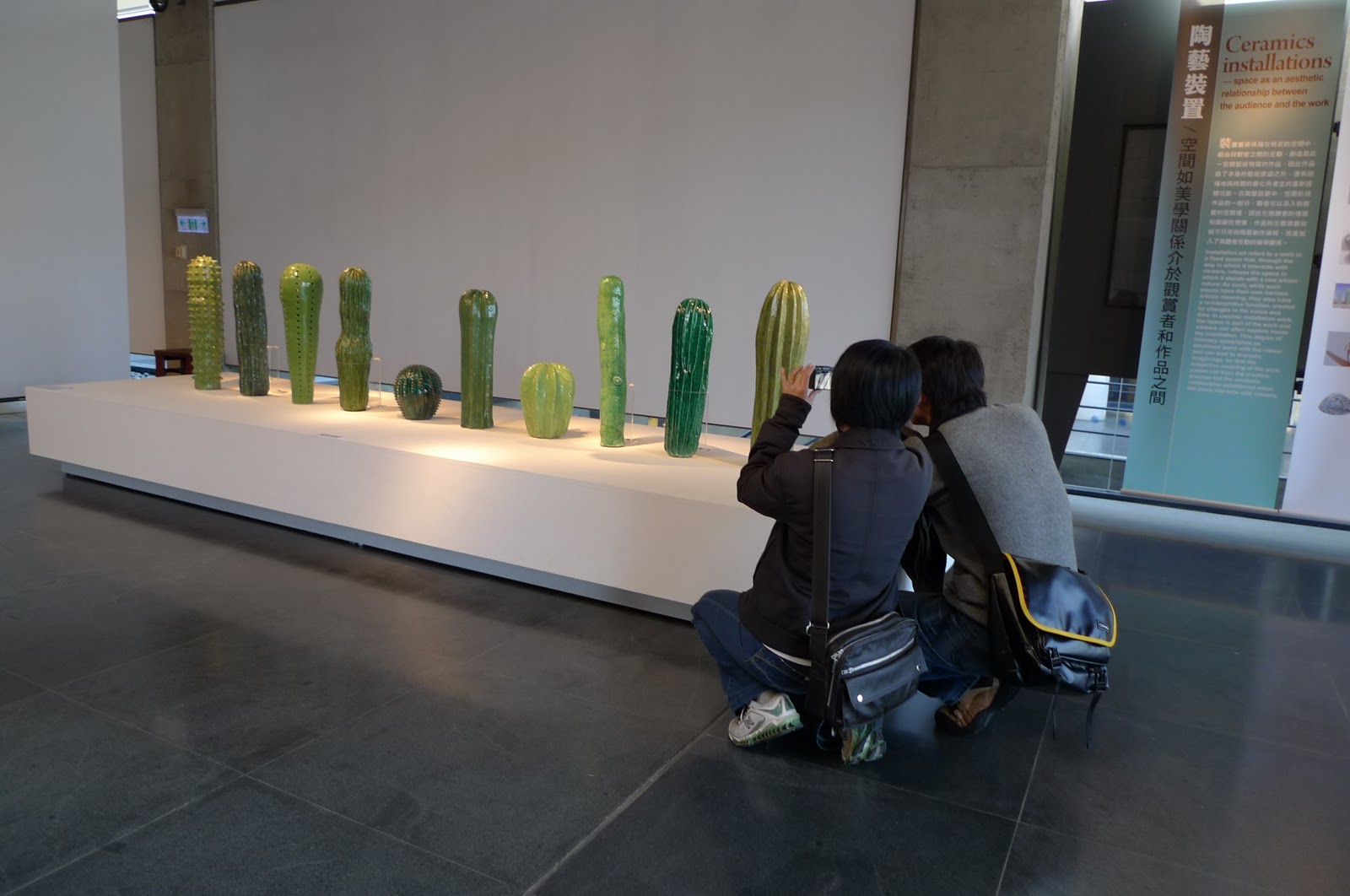


Serie Cactus by Lina Cofan, 2009


Nubes by Maria Bofill, 2007


Sin titulo I-V by Carmen Ballester, 2007


The museum also extends to a series of open parkland surrounding the building under the thematic names of Fire Arena, Earth Passage, Water Fount and Wind Channel, the elements that are indispensable in the making of ceramics.

All in all, the museum was rich in content, informative in its presentation and well managed.  From a close observation on the demeanour of museum personnel, be it concierge, security staff or even janitor, one could deduce how serious this establishment takes itself.  It was impressive in every detail.


Fire Arena


Earth Passage.  Yeah, a bit cheesy.


Water Fount


Wind Channel


The Guggenheim Museum in Bilbao immediately sprang to mind for comparison due to a recent visit.  Though located in different context, Yingge was definitely underrated whereas Bilbao, from this personal experience, was a let-down in general.  The shining titanium building designed by the starchitect, Frank Gehry, was a calculated hype that managed to lure flocks of visitors.


The label of Gehry was still a guarantee to success a decade ago.  The architecture as a shell was spectacularly predictable owing to its ubiquitous presence as quotable image; however the interior and exhibits did not live up to expectation at all.  It was a big budgeted project, to the effect of many Hollywood mega-movies loaded with big names, which did not endure in one’s loving memory.  Worse, after visiting hyped up museum like Bilbao, I occasionally lapse into the analogy of feeding on junk food: craving sensation beforehand but bad aftertaste to follow.


Expensive titanium cladding of Bilbao Guggenheim


Token interactive works by Richard Serra as part of the permanent collection in Bilbao.


Another article on Frank Gehry appears under the label of 'architecture'.


Tuesday, 1 February 2011

Demise of Egg House in Beijing


Egg House at public pavement.


Birth of an Idea

The 24 year old architect intern Dai Hai-fei (戴海飛) designed and built this ingenious home for himself in October 2010.  With around RMB6500 (US$1000), he built the egg shaped house that included a bed, small table and wash basin at the interior.  On the outside, it was cladded and insulated with sacking and glass seeds that was just beginning to grow in December 2010.  A small solar panel was installed to generate bear minimum lighting at night.  A green architecture true to form.


Bash all Non-conformists


His fast and unintended shot to fame through the internet, and later widely reported by conventional media, drawn in huge public attentions that relevant (or irrelevant) Beijing authority decided to remove Dai’s house on reason of illegal structure recently.

Overdose of Media Exposures

The China system, be it a way of life or implementation of law and order, can be surprisingly slack and varied.  This means the egg house could have survived a bit longer.  However by attracting too much attention, touchy to the Chinese government, the power of the internet and media this time has helped kill an innocent course.


A star is born, only very briefly.


Small sackcloths cladding the Egg House in detail.


At night, the house is simply surreal.


Nestled feeling of home.


Dai (third from left) was an idol outside the realty price spiralling game.


Monday, 24 January 2011

Derivative art doomed to be poor art


At the Beaux-Arts Ball of 1931 in New York, two dozens 
or so architects came dressing as buildings they designed.


William van Alen as Chrysler Building in company with 
unnamed female.


My memory proved me right that the image of people dressed up as buildings had crossed my mind before.  Oskar Schlemmer at Bauhaus was close but not the one.  It was the Beaux Arts Ball in New York, 1931 that I found in close resemblance to the work by Hong Kong artist Kacey Wong (黃國才).  The skyscraper attire was in every detail a derived copy of the Beaux Arts Ball costumes.  See images below.


"Drift City" in London.


"Drift City" in Egypt.


"Drift City" in Helsinki.


"Drift City" in China.


"Drift City" near the polar region.


Can it be purported to say that an artwork, ripping off from some notable piece, can be excused from due criticism?  Yes, only if one acknowledges the original; or it is a good art that transcends its precedent.  Minor art or parody can get away with murder but this is not the premises the artist seeks.  Wong claims that the work is arrived from the idea of an unnamed skyscraper pending demolition but suddenly disappeared overnight and found drifting around the world.  Perfectly solid but uninspiring, this postulation can be considered as one among many debates on lost identity in overdeveloped cities worldwide.

What is curious with the subject – a skyscraper awaiting demolition, is in fact a modern building not an historical one.  Maybe someone who dressed like an old building simply does not look as attractive as someone wearing a tall and slender skyscraper costume.  It could be the case that any thought of major changes from the original would debase a shaky concept.

Incidentally, keeping an old building can be a contentious issue and the issue is too complex for art to decide if the bulldozers should be called upon.  This also reminds me of what Rem Koolhaas said about people hypersensitive to preservation that even ordinary buildings of recent decades are being defended frantically.  Stripping out of context especially the urban fabric, an isolated discourse on preserving any building can be sentimental if not downright feeble.


Amélie, the 2001 film directed by Jean-Pierre Jeunet, coincided 
in timing with Kacey's snapshots around the world.


By any standard, the idea of “drifting” building does not worth the effort of spending ten years; and Wong claims that this is how long the project has taken from 2000 to 2010, posing with the costume around the world to demonstrate a fallacy.  It is absolutely a waste of resources from he himself and his sponsors.  The means does not justify the end no matter how much efforts and how long a time it takes.  The overworked photos only exacerbate the self-inflicted ridicule of the project.


Artwork of "Drift City" doomed.


Updating in June 2011:


Publication of the book - Drift City 10 Years 2000-2010, an unnecessary persistence on a dumb and pointless pursuit.


Tuesday, 18 January 2011

Parody of Kitsch

Ni Tsai Chin (倪再沁) and exhibition at 
Museum of Contemporary Art Taipei, Dec 2010.


I saw this exhibition by Ni Tsai Chin at the MOCA Taipei, Taiwan in Dec, 2010.  Ni went great lengths to parody on contemporary artists by making four large sculptures.  In doing so, he managed to make himself famous just like the artists he intended to criticize.  Judge for yourself if the works are inspiring parody, media hype, recycled attempt in art or simply trash.


A work (name untraecable) from Ni's Mediaholic series.


Two works (front and back, names untraceable) 
from Ni's Mediaholic series.


Puppy by Jeff Koons in 1992 and subsequently bought by Guggenheim Foundation for Bilbao in 1997. 


Balloon Animal by Koons in Versailles, 2008


Ni Tsai Chin (倪再沁), media happy.